Sunday, 28 April 2013

The quiet collapse of the pound

 
The forces ranged against the British pound may be so powerful that the government is in no position to offer inflation protection to savers.
 
I show above what has happened over the past five years. Nominally, UK inflation has advanced by 17 or 18 per cent, depending on how you choose to measure it.
 
Gold has soared, and had already done so for some time before 2008, but it had been at a low point for a long time during the years of the phoney boom. I still feel that, bearing in mind the amount of extra money pumped into the economy, gold is fairly valued. But compared to other assets it's a small market and so more volatile and subject to manipulation, so for the active trader it's full of traps:


So let's return to the first graph and look at the currency market instead, to get a feeling for our relative performance and a hint about the future.

The euro has risen 8% over the period - not dramatic, but the EU has its own large problems.

The US dollar has risen 29% and although it is an ailing giant, the dollar is still the world's major reserve and trading currency, so when crisis hits there may be a flight to USD. Longer term, the US economy is out of kilter, like that of the UK and EU, so all three are in a quandary - the choices appear to be painful deflation and social unrest, monetary inflation with all that attends it, or debt defaults and forgiveness (which powerful creditors are determined to prevent).

My feeling is that the UK will pursue the first course until it's politically impossible, then the second (by which time the smart money will have got out, as happened in a different way in the Cyprus bank debacle).

The orange columns (except for Saudi Arabia) show the progress of the six currencies tipped for 2013 by the Money Morning website. I have no idea whether their recommendations are good. And again, I'm not one of these nimble traders that draw lines all over their charts and make references to the Fibonacci series, tramlines, head and shoulders etc. Like all professional gamblers, they're terrific until they get to the point where they sell their binoculars for one last punt. Good luck to them but I haven't got their nerve.

What I'm looking for - and what was available for 35 years in this country, until the Coalition took over in 2010 - is something for the humble saver. Something safe that will simply hold its value in spending terms, after inflation and taxation. In short, something that makes saving worthwhile, instead of a form of slow financial suicide. I don't see why the cautious, prudent saver has to choose between losing to the pickpocket of inflation, or alternatively to the croupiers in the marble-halled casino of stocks and bonds.

But we may have gone beyond the point of finding the right bank for our safe haven; we could be at the stage of backing the right country. There's a stealthy run on the banks going on now - not only in Cyprus, but capital flight from the Euro area; soon enough, I fear, there'll be a sort of run on countries.

In which case, I'd be looking for one that is politically stable, balances its budget, is strong enough to defend itself (and isn't near a psycho state like North Korea), doesn't feel obliged to join in competitive devaluation to maintain its exports, doesn't have porous borders or an over-generous welfare system, and has what other countries will still want once the international disaster is over.

Australia, with its industry-relevant natural resources? The USA, with its high arable land-to-population ratio?

Wish I knew. Perhaps I should back all the best horses in the race. But one thing seems clear to me: the UK is not one of them.

All original material is copyright of its author. Fair use permitted. Contact via comment. Nothing here should be taken as personal advice, financial or otherwise. No liability is accepted for third-party content, whether incorporated in or linked to this blog; or for unintentional error and inaccuracy. The blog author may have, or intend to change, a personal position in any stock or other kind of investment mentioned.

Fighting the Government for savers and against inflation (2)

This series is a report on my attempts to get questions raised in Parliament about the Government's failure to protect small savers against inflation, taxes and theft by banks. Part 1 is here.

The latest news that should (ought to) turn up the gas under this issue is Matt Taibbi's article for next month's edition of Rollling Stone magazine (htp: Jesse) detailing another gigantic price-fixing swindle by banks who have previously been exposed in the Libor scandal. As Taibbi reports, not only has the door opened to reveal that virtually all markets are rigged (against us, the ordinary people), but - astoundingly - an American court has accepted defendants' argument that nobody expected the interest rate market not to be fixed.

All the more reason why you might look at the Move Your Money website.

Here are some of the newer email exchanges between myself, my MP and his researcher:

MP to me - March 3, 2013:

I am happy if you wish to work with my researcher on written parliamentary questions on this issue.

(N.B. note the "written")

Researcher to me - March 12, 2013:

[...] I understand you wish to ask ministers about maintaining the value of savings vis a vis inflation and purchasing power parity of the pound against other currencies – it would help if you could give me an indication of exactly what you would like to ask or if you could draft a question I could amend?

For instance, I’m not sure if you would like to simply ask a question along the lines of ‘ To ask the Chancellor of the exchequer what steps he has taken or plans to undertake to maintain the value of savings against increased inflation and devaluations of the pound’ -- or alternatively you might want to ask the Treasury if you have a particular scheme or strategy you would like them to adopt?

Don’t worry about phrasing, I can amend a question so that it will be accepted by the table office.

We can table a written parliamentary question to any department with ease and departmental oral questions in the house occur every few weeks, I am sure we could arrange for John to ask an oral question if his diary allows – Questions to the Prime Minister during PMQs on a Wednesday are more tricky – you can put in written Questions for oral response or try to catch the eye of the speaker if you are a member, but demand is, obviously, high and this would require John to both be in the chamber and willing to use what is an infrequent opportunity to gain significant publicity for a cause, on this issue. That’s not saying he would be unwilling to do so but I don’t know if he has an issue he does want to raise at PMQs and it might take a few months before that opportunity presents itself.

A written or oral question to the Treasury would be most feasible with a reasonable turnaround on a response.
 
Me to researcher - March 12, 2013:
 
[...] I have some ammo to use in framing questions, the idea being to get govt to accept that there is a moral case for protecting the value of savers' money and in fact there's a couple of passages in Hansard that strigly  [sic; intended "strongly"] indicate that acceptance in the year that NS&I Index-Linked Savings Certificates were first introduced.

It may well be true that the financial situation is serious, as your boss says - in fact I've been blogging about it since 2007 and warned of the banking crash both there and in the letters pages of the Spectator - but there is absolutely no justification for making the prudent pay the cost, or for forcing them to gamble with their money just in order to try to avoid losing it to inflation.

I wd very much like your help in framing Qs that will make the ministers, Chancellor and PM bloody well squirm.
 
Researcher to me - April 18, 2013
 
I’ve still got this on my list of things to do – You suggested you would be back in touch, but I do not seem to have a follow up email from you since the one below

Could you confirm if you have a question in mind, or if the more general one I suggested below would suffice? [The question was omitted from his email]

Me to researcher - April 21, 2013:

Sorry, been away a few days.

I don't see the general question you refer to, but since Cyprus I have two serious worries - which should apply to many of my ex-clients and people generally:

1. How to set aside money and preserve its spending value, without being eroded by inflation and taxes and without being forced to accept any kind of investment risk;

2. How to be sure that no portion of savings below the deposit insurance ceiling will not be seized in some form of bank bail-in or pseudo-tax, but be payable in the form and to the schedule expected by the saver.

I understand that Tam Dalyell was feared as a Parliamentary questioner because his questions were short, to the point and allowed no room for irrelevant waffle in reply. Do you think you could frame questions on that model?

Also, should they not be asked as PMQs rather than handed off to get some dusty reply from the Treasury? My experience of the latter pretty much destroyed my confidence in getting anything other than fluff and party political twaddle.
 
No reply received before my next email to him - April 27, 2013:
 
Further to my last email of 6 days ago, perhaps you could spare the time to look at the latest article by Matt Taibbi in Rolling Stone. It may give you some idea of why I now (as a former IFA of 23 years' experience in the financial industry) regard the whole bank and trading shebang as irredeemably systemically corrupt. Any government that wishes to retain its claim to authority needs to protect the life savings of the little people.

http://www.rollingstone.com/politics/news/everything-is-rigged-the-biggest-financial-scandal-yet-20130425

Do please let me know how you are getting on with framing appropriate questions as previously discussed.

Best wishes

All original material is copyright of its author. Fair use permitted. Contact via comment. Nothing here should be taken as personal advice, financial or otherwise. No liability is accepted for third-party content, whether incorporated in or linked to this blog; or for unintentional error and inaccuracy. The blog author may have, or intend to change, a personal position in any stock or other kind of investment mentioned.

Friday, 12 April 2013

Gold market crashes!


All original material is copyright of its author. Fair use permitted. Contact via comment. Nothing here should be taken as personal advice, financial or otherwise. No liability is accepted for third-party content, whether incorporated in or linked to this blog; or for unintentional error and inaccuracy. The blog author may have, or intend to change, a personal position in any stock or other kind of investment mentioned.

Tuesday, 9 April 2013

Mrs Thatcher and inflation: a letter to the Spectator

Republished from 16 January 2010 (N.B. BoE M4 data from 1963 - 1981 has recently been redacted, without explanation):

Sir;

Sir Peregrine Worsthorne (Letters, 16 January) may have been right to support Mrs Thatcher for confronting the unions, but I believe he is wholly mistaken when he says she tackled inflation. Thanks to the opening up of global markets, consumer prices have been lowered by cheap foreign labour, indirectly by the importation of goods, and directly by the deliberately uncontrolled immigration of low-paid workers. However, behind the scenes there has been massive long-term monetary inflation, the woeful consequences of which we are now merely beginning to suffer. Economics may seem rather dry, but its implications are correspondingly fiery and so I hope your magazine will allow room for explanation.

Comparing GDP with (M4) bank lending figures from the Bank of England’s website, which gives data from 1963 on, we see that annual increases in lending almost always outstrip increases in GDP, but sometimes far more so than others. The worst was in 1972, when M4 increased by 35% (GDP grew by only 12%); the fear of monetary inflation and its potential effect on exchange rates may have been a major factor in OPEC’s decision to hike oil prices in 1973, which triggered years of high price inflation in the UK and the humiliating IMF rescue in 1976. Lending increases dropped below GDP between 1974 and 1977, then resumed ascendancy, though not in time to rescue James Callaghan’s premiership.

But inflation did wonders for Mrs Thatcher. The average annual excess of M4 growth over GDP in 1964-79 was 2%; from 1979-1990, the “Thatcher years”, it averaged 8% (and about 4% p.a. thereafter). The results have included overspending on luxuries; the loss of jobs and industrial skills; the export of machinery and tools; and a huge exaggeration of property and stock valuations. Worse, we now have a large class of economic dependants, both home-grown and recently imported, whose support costs cannot be externalised as easily as our manufacturing capacity.

Sir Peregrine may not divine in Mr Cameron the architect of our rescue, but I fear the situation may now have developed well beyond any man’s power to amend without reform on a scale that may not be entirely possible in a democratic society.

UK: Money-movers play catch-me-if-you-can


The global financial crisis is also a local issue for the UK, dubbed the 'global capital of money-laundering' in a Private Eye magazine investigation by Richard Brooks (August 2012).

The role of the financial sector in Britain ballooned in the years before the breakdown: this 2011 report by the Bank of England (pdf) shows that its annual growth was 6%, twice that of the economy as a whole.

That's why we need it. But why does the rest of the world need it to be in London?

In part the answer is that, as David Malone explains below, our system is particularly good at handling money without asking too many awkward questions. Shell companies make it hard to track down who is running businesses.

Moreover, unless money is definitely proved to have come from illegal activities, the authorities are unable to treat money transfers as criminal "money-laundering". Malone's only censored post to date, from which he quotes sections here, was a detailed investigation for Reuters into alleged money-laundering in Cyprus; but his original piece fell foul of that (perfectly logical, of course) lack-of-predicate-crime rule.

In this context it's worth remembering that the UK is also known as the "libel capital of the world", with potentially big payouts for plaintiffs if the defendant cannot prove his allegations (up to three years ago, it could get much worse than a civil court case: there was such a thing as criminal libel, punishable by imprisonment - this was what caused Private Eye's then editor Richard Ingrams to throw in the sponge when Sir James Goldsmith pursued him in July 1976).

And now, following the Leveson inquiry into abuses by mainstream journalists, bloggers may find themselves at risk of high financial penalties, without having the legal and financial resources of the conventional Press to help defend themselves.

I also reproduce here a piece by France-based blogger John Ward, reporting on the vast quantities of cash held in offshore banks that might (if captured onshore) otherwise contribute up to a trillion pounds to the UK economy.

In a digitised world, capital can zip around the globe far faster than leaden-footed regulators and tax authorities. Cyber-money is also very useful for dodging attempts by local banks to grab it to shore up their reserves, as we are seeing in Cyprus - and this article on Charles Hugh Smith's site goes further, implying that EU banks may have influenced a delay in the European Central Bank's enforcement action against the island, to allow them time to extract most of their cash before the shutters went down.

Finally, delay can help bosses as well as the banks they run: there is much noise being made at the moment about "examining powers to take legal action" against three directors of HBOS who were on watch when billions were lost by their company; but the Financial Services Authority has a strict time limit of three years to take disciplinary action against individuals, and that deadline has come and gone. A cynic might wonder why exactly the FSA missed it, but the fact remains that we have to obey the law as it stands, so I don't expect any retrospective ruling against these people, who are far from the only ones to have (allegedly) overseen significant losses in the banking sector.

My sincere thanks to David Malone and John Ward for permission to reproduce their posts.
________________________________________________

Making the Truth Illegal – revisited


“Making the Truth Illegal” is the title of the only post I have ever removed from this blog.
I removed it because I was threatened with legal consequences if I did not. (Plus, I would like to add, some of the way I had written the blog post was stupid and could have hurt someone who had helped me.)

The post concerned an article I had written for Reuters which they decided they could not/would not publish. Reuters pulled the article because they and I had been threatened, by a major European Bank, with legal consequences if they did not. The title of the article was “Cyprus, Magnitsky and the truth about Money Laundering.”

Although I cannot publish the article I can show you how it began and tell you how it is, that the truth it contained was made illegal.

The article began:
Money laundering is the life blood of organized crime. Without it crime would simply not pay. But who does the laundering? The easy and obvious answer is criminals. But that is completely wrong and is at the root of our inability to stop it.

Criminals are the people who need money laundering. They are the clients. But they do not, themselves, know how to launder money. The only people who do know, and who are in positions to do it, are those whose day jobs are the many professional services which make up laundering: the accountants, lawyers, company registration and management agents, account managers in banks and company directors in companies that have no reason to be, other than to pass hot money through an endless spin cycle. In organized crime, criminals provide the crime but professionals provide the organization.
Of course we could get jesuitical about it and say, but those professionals who launder are criminals. Which would be fine, except that we do not treat them as criminals. Criminals break laws. Professionals do not, they have ‘failures of compliance’. One is considered an active, purposeful ‘doing’ of something, for which punishment is de rigeur. The other is excused as an unfortunate and unintentional ‘not doing’; an oversight, omisssion or failure to do, for which one and one’s employer get admonished to ‘do’ better. And as long as you promise you will, all is considered fine and finished. There may be a small fine but nothing to lose your bonus over. No one senior ever goes to gaol.

Criminals are investigated – by police. Professionals are ‘regulated’ – usually, and rather conveniently, by themselves or colleagues. People who rob banks have legal problems. People in banks, who rob people, or help others to rob them by laundering their money for them, they have regulatory issues. One is serious the other is a joke. How many bankers actually went to prison from Wachovia or Citi or HSBC?

All this might seem rather sweeping. But it is not. It is just that usually we do not get to hear about the people and businesses who do the actual laundering nor what happens to them afterwards. When money laundering is reported it is usually the lurid details of the clients of the money laundering, the drug cartels and terrorist organization, who get all the headlines. Hardly ever do we hear of the launderers themselves. And that is because, as already noted, they are never ‘guilty’ of having ‘done’ anything. But events in Cyprus have recently given us a rare opportunity to lift the sewer’s cover, peer inside and see at least some of the people who failed to act; who by omission, oversight, laziness or complicity, intentionally or otherwise, ‘helped’ to launder money.

As the philosopher Edmund Burke famously noted, “All that is necessary for the triumph of evil is that good men do nothing”.
As you can see the purpose of the article was not simply to prove, what everyone already knew, that Cyprus had indeed been laundering dirty Russian money, but to say something about WHO actually does the laundering. The point was to finger the launderers themselves not their clients. Of course that meant naming companies, lawyers, company directors, company registration agents, and last but not least, the banks and individuals in them. These are, of course, people who are not used to the idea that they can be named, take grave exception to being named and who have the power, I discovered, to make sure they are not.

The article also did one further thing. When you added it all together and told the whole tale in all its detail, with all the names, dates, places and amounts, one further conclusion jumped out. The lawyers, accountants, company directors and bankers, who did the laundering, are also the people who the anti money-laundering system relies upon to police the system and stop the laundering. The inescapable conclusion is that the anti-money laundering system not only does not work, but seems expressly fashioned to make sure it does not work.

It is possible – it happened in the Magnitsky case – for a criminal to buy a bank and be granted a bank license. Yet the law says it is the directors of such a bank who will be relied upon to contact the authorities about suspicious transactions. Criminals don’t often turn themselves in, yet in every country this is the non-system our leaders and financial experts maintain. In the UK the law is set up so that a company can be set up without any due diligence at all being done to determine the character let alone the actual identity of the owner. Because of this ‘loophole’ as the authorities coyly refer to it, the UK is home to tens of thousands of shell companies set up by criminals and used for criminal purposes. This may sound like a fantastic charge and one I cannot possibly substantiate. Yet almost every major case of fraud or money laundering will involve UK shell companies. Follow the Magnitsky money and you will see it pass thorough UK shell companies. The same goes for the $64 billion of state money stolen from Kyrgyzstan much of it then passed through UK shell companies. Or the on-going case of money laundered out of Ukraine by means of a fake oil rig purchase. That money too passed through UK companies.

I could give you plenty of other examples but the important point is that NO ONE in authority can offer a shred of evidence to show that I am wrong no matter how many criminal companies I claim there are likely to be, for one simple reason. THEY HAVE NO IDEA WHO OWNS THE COMPANIES. The system is set up so no one knows. Companies register owners but they can be other companies in other jurisdictions. And it is easy to set up a company in such a way so that no one checks on the owner at all, ever. That is the system we maintain.

Every minister who has ever had the power to change this state of affairs has been aware of this but they have all chosen to leave it that way.

In short we have a system which is conveniently designed so it does not stop money laundering but does make sure no one will be prosecuted. It serves to shield the guilty not stop them.

I realize these are statements that can still be dismissed as ‘conspiracy’. Without the 8000 words of detail the article contained, without the references to over a hundred pages of bank transfers and company records, I am left with just what I know to be the case without being able to show you what convinced me.

All I can do, as promised, is show you the final ‘shell’ which surrounds everything else and which allows the rest of the corrupt system to exist and do its job. The last shell is a legal one and I had not understood its importance, nor its power, until it did its job and stopped me publishing.

This is how it works.

First a few facts. In the Magnitsky case $230 million was stolen from the Russian state. That money was then laundered in a scheme that involved five deaths, a lorry load of bank records that exploded, eight banks, numerous shell companies and complete, abject and total regulatory failure. It is called the Magnitsky case after Sergei Magnitsky who was found dead, handcuffed on the floor of a cell in a Russian prison. His body, photographed at the time, was covered in bruises.

Mr Magnitsky had been arrested and then held without charge or trial in the custody of the Russian Interior Ministry for nearly a year. He had been detained shortly after he had named in official testimony Interior Ministry officials and certain tax officials as the criminals behind the theft. The men he named were the ones who arranged his detention.

BUT, the Interior Ministry held its own investigation. What it found was that although the money had indeed ‘gone missing’, none of the officials Mr Magnitsky had named were, according to their official investigation, guilty of anything other than being ‘tricked’ by person or persons unknown. The Ministry did try to suggest several culprits but two of them died mysteriously of heart attacks a thousand kilometres from their homes before they could testify, while another had, rather embarrassingly, died before the crime he was accused of had even been committed. The Ministry looked silly even by Russian standards and no case was brought.

Eventually the Russian officials accused the deceased Mr Magnitsky of being the mastermind behind the crime he had been investigating. At one point the Russian state said it was going to put him on trial posthumously. So far it has not. And thus the case rests with the conclusion that there was no crime, only a ‘trick’ with no one found guilty.

It was also decided in Mr Magnitsky’s absence that despite the photographic evidence of his beaten body, he had died of natural causes and no crime had been committed there either. Case closed. And that ‘Case closed’ is what it is all about.

In the end it doesn’t matter what actually happened nor what evidence is to hand. As long as some official body does its own ‘investigation’ from which it concludes nothing happened, then nothing did, and the case can be closed. Not only that but if anyone should try to look for themselves at the evidence they cannot refer to anyone or any bank as being involved in criminal behaviour of any kind. Because there wasn’t any.

If no money was stolen – and none was because the Russian said so – then no one could have laundered any. How can you launder money that was not stolen?

The Russian decision meant, in legal parlance, that there was no ‘predicate’ crime – no crime from which other crimes followed. Which means, if one authority says there was no crime, every other authority in every other country, should it want to, can point to this judgment and say, ‘why should we investigate anything if there was no crime in the first place?’

This meant when an official complaint was sent to the Cypriot authorities in 2008 alerting them to the Magnitsky affair, right at its beginning, they could ignore it. And they did. The Cypriot police were sent an official complaint in 2008, and to this day they have never replied to it nor even questioned the people, even Cypriot people, named in it.

In fact even when the Cypriot Authorities were sent another much more detailed complaint in 2012, which gave them dozens of leads and lines of enquiry they wrote back saying,
“…it is important that we firstly obtain information from the Russian authorities about the predicate offence or offences committed in Russia.
Thus we plan to contact the Russian authorities in order to obtain information…”
And of course there was no predicate crime. Not officially. Even though companies were stolen and hundreds of millions did ‘go missing’.

Similarly, in 2010 another complaint was sent about the Magnitsky affair, this time to the Austrian authorities. The complaint alleged that the very large and powerful Austrian bank Raiffeisen, had handled much of the money that had ‘gone missing’. The Austrian authorities opened an investigation which concluded Raiffeisen had done nothing wrong at all. Case closed.

The Russians found no crime had been committed on their patch. The Austrians found nothing on their patch either.

This is despite the fact that Raiffeisen did handle the money. But you see handling is NOT laundering. Laundering requires the money be illicit AND that Raiffeisen knew, or reasonably could have known, the money was illicit. And the Austrian regulator concluded that Raiffeisen could not have known there was anything wrong with either the money it was handling, nor the bank from which it came nor the owner of that bank. The owner we are talking about here is the criminal – a convicted criminal who owned his own bank – mentioned earlier. According to Raiffeisen and the Austrian regulator the criminal past of the owner of the bank Raiffeisen was doing business with, could not have been known till a later date.

Now I find this judgement to be difficult to understand since the man in question had been convicted in Russian court in 2006. There are court transcripts of his admission of guilt which I have read. Yet Raiffeisen was handling the money in question in 2008.

BUT it doesn’t matter if I or you find this odd. The only FACT that is important, is that the Austrian regulator looked and found Raiffeisen NOT guilty of any crime. And so they are innocent. Case closed.

This is how you can end up, as I did, compiling facts and dates, evidence of bank transfers subpoenaed in court, which lead you to a conclusion that you are nevertheless not allowed to make public. You can present all the evidence but you must contrive to do it without ever mentioning the name of a crime, nor suggesting any illegal activity in the piece. And of course you certainly cannot conclude in writing what the evidence suggests. If you try to , as I found, you are threatened with the law.

And that is how you make the truth illegal.

If this was just one case it would be horrible but isolated. But it is not. This use of official and legal judgements to squash the truth is exactly what happened in the case of Jonathan Sugarman and UniCredit. He found evidence that UniCredit was very seriously breaking the law. He got an outside company to check and they agreed. The Irish regultor however, said, ‘There’s nothing to see here move along’. And Jonathan was threatened with leagal action if he did not go quietly away and hide.
What does all this mean for money laundering?

Here is how I concluded the article I cannot publish.
People love to talk about the ‘risks to banks and companies’ from money laundering. What risks? Think of the notorious cases of money laundering before Magnitsky: Citi., Wachovia, HSBC. No one was gaoled. No one senior even lost their job. Fines are a joke. Wachovia, for example handled or laundered over $370 billion of dirty or suspect money out of Mexico. They were fined one two thousandth of that amount, just $160 million. As a percentage of the direct financial benefits accrued to Wachovia, from having the dirty money flowing through their books, fines for money laundering are vanishingly small and better thought of as a tip pressed into the palm of a compliant doorman.

In reality, simply looking at the facts of what it has cost the banks in gaol time, fines or even something as intangible as their standing with their regulators and governments, it is very much worth it to launder. As for ‘standing’ or reputation – being guilty of huge money laundering did no harm to Citi when it came to bailing them out. Nothing untoward has happened to Wachovia or HSBC. In short – on a cost benefit analysis I would say it is of huge benefit and virtually no risk, for any bank large enough to be able to launder money, to do so.

And what of all the many companies and professionals, the company agents, lawyers and accountants, who do the jobs which make up the bulk of the work of laundering? Are there any real risks for them? I would say there are few because our system simply does not investigate what they choose to do. Instead it is very careful to only ask them to fill out forms, to self regulate and to ‘comply’.

I think the questions we need to ask ourselves and our politicians is why is it that the financial world is ‘regulated ‘ while we, ordinary citizens, are policed? Why do they have regulations to observe, while we have laws to obey? Why are they asked to merely assess themselves while we are investigated by officers of the law? Who profits from this careful double standard?

When you boil it all down, anti-money laundering is about asking criminals and the law abiding, both, to write reports about themselves. Needless to say the criminals lie. But we pretend not to notice, and so in every country all the paperwork says there is no money laundering going on. Yet hundreds of billions is laundered every year.
 
________________________________________________
Now, John Ward's post:

THE EVADERS: British banks control enough tax evasion to almost pay off our National Debt at a stroke

A story goes global, and damns the self-styled elite

UKgdpdebt
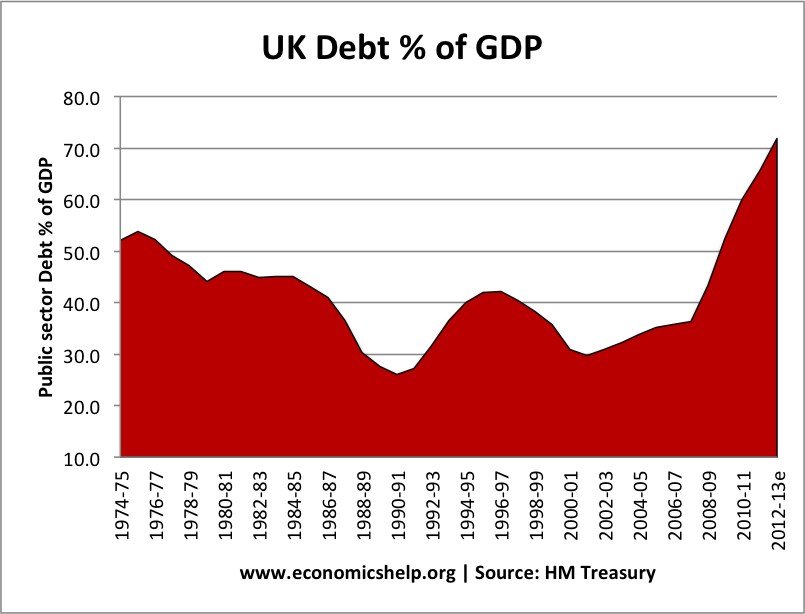
UK debt versus GDP…would be transformed if tax evaders paid their way
 
The amount of tax-haven monies controlled by British banking is estimated to be £1.26trillion. That is six NHS budgets, twenty defence budgets, eighteen welfare budgets, and five UK State pension budgets planned for the UK’s 2014 fiscal year. The evasion total is the same size as the entire public sector pension fund, and only slightly smaller than Britain’s total national debt.

Last Friday, every French newspaper’s front-page from the Rightist Le Figaro to the Leftist Liberation led with the series of offshore tax haven scandals now threatening to overwhelm President Francois Hollande. In the UK, the Virgin Islands name-and-blame game has put David Cameron very seriously on the back foot. And the obvious connection between Tory newspaper The Daily Telegraph’s ownership and the Sark tax-evasion scandals there has shaken many from their torpor of bland acceptance. Throughout Europe’s citizenry this morning, there is a growing feeling that – far from being a tiny minority – rich-businessman tax evasion is the norm.

The Irish Times last Saturday threw up a staggering statistic: over 30,000 Irish firms have directors registered in offshore jurisdictions. Furthermore, in Sark specifically – population 600 – there are more than 11,000 bank accounts of directors registered to Irish firms – 18 for every island resident. There are roughly 560,000 business enterprises in the Irish Republic, of which no more than 240,000 could be described as turning over enough to make directors’ offshore holdings worthwhile. Thus an incredible 1 in 8 of the country’s business élite is stealing from the taxman.

This isn’t going down well among Ireland’s poorer classes – not least because Enterprise Ireland’s own data showed that over a thousand of its business members received government funding in 2010, with a total of 86 receiving commitments for financial support in excess of €100,000 for significant R&D projects. Life is a thing of give and take, but for Ireland’s top earners it seems to be all take and no give.

Coming in the wake of similar behaviour over the last five years from the West’s bankers and the Greek econo-political class, there is something about offshore – and the Virgin Islands story in particular – that seems to have completed a synapse connection….thus allowing the penny to drop at last: the ordinary folks are being gang-raped by greed on all sides.

As many of us always suspected, the insouciant wealth-accumulation obsession of frontal-lobe afflicted bankers is what joins them at the hip with the top earners in business – regardless of which country or culture one surveys. The ever-unpleasant HSBC’s Guernsey operation was last November shown to be shielding £699m in 4,388 accounts in Jersey – with one investor holding £6million. The average balance is £337,000. Equally, the true extent of American and German fat cat tax-evasion has been unearthed by the German Federal Intelligence Service. It is conducting a widespread investigation into Lichtenstein banking – and that of Luxembourg – where tens of thousands of US and Bundesrepublik tax evaders are hiding massive amounts of cash.

A 2012 study of 60 large US companies found that they deposited $166 billion in offshore accounts during 2012, sheltering over 40% of their profits from U.S. taxes. Yet Wolfgang Schäuble has invested a great deal of spin-time trying to suggest that Cyprus shielding the wealth of crooked Russians was atypically evil enough to warrant Berlin’s snaffling of the island’s potential energy economy. This is now shown to have been bollocks not just as a rationale, but also in its alleged uniqueness. And some of Wolfie’s mates appear to be up their eyes in similar operations around the world.

But the burgeoning scandal is more embarrassing for David ‘Legup’ Cameron than any other leader because, as the Guardian for once reported accurately at the weekend, ‘one nation in particular has ties to offshore havens everywhere. It’s a veritable nexus of offshore influence, related to havens in the Caribbean, and much closer to home. That nation is, of course, the United Kingdom.’

As so often happens today, without the leaking of more than 2m offshore files to the International Consortium of Investigative Journalists (ICIJ), the extent of this three-faced hypocrisy would be unknown to us still. So while George Osborne talks a good game about “all being in this together” – and Cameron witters on about “not wanting to associate with” tax evaders – the reality is their administration and bankrolling ranks are crammed with some of the worst offenders and facilitators. Lord Green ran HSBC for years, Jeremy Hunt is an aggressive tax-avoider, the Barclay Brothers run Sark, Boris Johnson is a particular favourite of the Sarkist-Banking fraternity, and numerous large Tory donors are among the wealthy ripping off Sovereign revenue offices: more than 175,000 UK companies have directors in offshore jurisdictions.

The ICIJ’s project uncovered a network of empty holding companies and names essentially rented out to fill out boards of non-existent corporations, including a British couple listed as active in more than 2,000 entities. This is a mirror image of the tiny survey conducted by The Slog last week into the identity of those who were early departees from the Cyprus depositor haircut.

For me, however, it is a calculation of the totals involved globally that change these revelations from being just another “it’s the rich what gets the sorrow” yarn into something that just might – we live and hope – finally get Middle England off its sofa and angry enough to demand justice.

A 2012 report from the Tax Justice Network (a UK company) estimated that between $21 trillion and $32 trillion is sheltered from taxes in unreported tax havens worldwide. Tax havens have 1.2% of the world’s population and hold 26% of the world’s wealth – including 31% of the net profits of United States multinationals. We are indeed talking about ‘a tiny minority’ here – the usual suspects – but also a colossal percentage of the money that should have been paid in Sovereign taxes. Financial opinion leaders I asked last week for an estimate of the percentage of offshore monies administered by British banking thought the number to be between 40 and 60%.

Being kind to the perpetrators and assuming (a) the lower end of those estimates and (b) lowest assessments of global market size and (c) a net tax rate of 15% being evaded, the Government of the United Kingdom knowingly loses almost exactly a trillion pounds in tax revenue thanks to the havenism endemic in the banking system it is supposed to regulate.

That is six NHS budgets, twenty defence budgets, eighteen welfare budgets, and five UK State pension budgets planned for the UK’s 2014 fiscal year. The evasion total is the same size as the entire public sector pension fund (itself a disgrace of illegal embezzlement) and only slightly smaller than Britain’s total national debt.

It is a mind-boggling 70% of United Kingdom GDP.

But here’s the final brass-necked irony: stand by for an attempt by the Global Looters to use this tax evasion reality as the excuse for stealing the savings of everyone with over £100,000 in a bank account that isn’t offshore….and represents the life-savings of a law-abiding taxpayer.
________________________________________________

Principal articles reproduced / referenced above:
All original material is copyright of its author. Fair use permitted. Contact via comment. Nothing here should be taken as personal advice, financial or otherwise. No liability is accepted for third-party content, whether incorporated in or linked to this blog; or for unintentional error and inaccuracy. The blog author may have, or intend to change, a personal position in any stock or other kind of investment mentioned.

Monday, 1 April 2013

New government plan: "Send them all to China"


The Chancellor of the Exchequer, Mr George Osborne will later today unveil radical proposals for tackling the financial burden of the benefits system. It will replace the controversial "bedroom tax" with a package of reforms even more ambitious than the postwar establishment of the Welfare State.

The central plank of the proposals is that all those who, over their lifetime, are likely to receive more in benefits of all kinds than they pay in taxes, are to be relocated to China and supported there, far more cheaply. This will greatly ease the pressure on British housing stock, and at the same time create much-needed additional demand for the PRC's 64 million unoccupied apartments, many of them brand-new.

The scheme's potential is staggering. For example, there are an estimated 1.8 million people in "pensioner poverty", 2.5 million unemployed, 3.5 million low paid workers, 1.7 million children with special needs and 11 million disabled, which suggests that up to 20 million Britons could be set for the one-way plane (or slow boat) trip to China's provinces.

"The exact figures are impossible to assess at this time," said a spokesman. "Partly, this is because the savings will be so great that taxes can be slashed, which will have a knock-on effect on prices. So people who previously would have been categorised as poor will find it much easier to make ends meet.

"However, this factor is likely to be counteracted by the economic impact on huge numbers of people whose living depends wholly or partly on servicing the poor. Social workers, DWP claim processors, special needs teachers, nurses, occupational therapists, psychologists, police, lawyers of all types, magistrates, prison officers, charity professionals, pubs and off licenses, betting shops, the National Lottery, cheap supermarkets, compensation claim outfits, loan sharks, Chinese takeaways... the list is endless.

"All these will see their income reduced, and some will fall into the same bracket as their former clients and customers. The latter will be offered the choice of continuing in their role, but on Chinese pay rates and conditions, or simply becoming claimants themselves."

A confidential source tells us, "Osborne's team had intended to work through the details for at least another year, but the Americans had got wind of it and so the announcement has had to be brought forward to beat them to the punch." It is understood that half the empty houses in China have been reserved for the UK.

The plan has no official name as yet; but some say it will be dubbed the "Osborne resettlement plan", others think it will be called the "Shipham Scheme" in order to allow the Chancellor to distance himself from it if it turns out to be a failure.

Speaking from New York in his new position as president and chief executive of the International Rescue Committee, Mr David Miliband said, "What this plan really shows is the importance of pay rises for the poor, since we all need them, especially my Party." Mr Miliband pledged to contribute a proportion of his £280,000 salary towards a fighting fund to oppose Mr Osborne's plans; asked exactly how much he was intending to give, he replied that it was hard to say, as he needed to relax a lot in a job like his.

All original material is copyright of its author. Fair use permitted. Contact via comment. Nothing here should be taken as personal advice, financial or otherwise. No liability is accepted for third-party content, whether incorporated in or linked to this blog; or for unintentional error and inaccuracy. The blog author may have, or intend to change, a personal position in any stock or other kind of investment mentioned.

Saturday, 30 March 2013

John Ward calls for debt default via democratic election

Reposted from John Ward's blog, at his open invitation...
 
 
Why electing defaulters to power is the only way left
 
Friday having seen the enthusiastic support of De Nederlandsche Bank President Klaas Knot for Djisselbloem’s plan to pick the pockets of every despositor in Europe, there are now hardly any major nations still in the closet when it comes to Global Looting.

On Thursday, Canadian bloggers cottoned on to the plans of their government via the annual budget statement. On pages 144 and 145 of “Economic Action Plan 2013″ (already submitted to the Canadian House of Commons), it openly proposes ‘to implement a ‘bail-in’ regime for systemically important banks’ there.

The second wave of evidence about what’s coming I referred to yesterday: the banks hastily sending out acres of fly-shit to their customers to blame any future disappearance of money-substances from their accounts. The general line of defence being offering by these creeps is “ve are only obeyink orders”. The first one out of the blocks appears to have been Santander. Yesterday, the one from HSBC started landing on Slogger doormats. Guess what? The wording and headings are exactly the same as the Santander mailshots.

In short, the entire operation is being coordinated and run by the Treasury. Any chance of Ed Miliband – our friend in tough times – asking a PMQ about this next Wednesday? Don’t hold your breath. Our MPs these days simply do as they’re told, or what they want – whichever is the easiest and most profitable route at the time.

What we are seeing come to pass at the moment is what those previously nutwhack sites from three years ago were screaming at a deaf audience: in the end, they’ll confiscate our money to bail out the lunatics. But where will it end?

There’s a Radio 4 audio clip of Michael Winner at his best in the BBC archives, grumbling two decades ago about how restaurants steal from their customers. Winner says:

“I called a waiter over and said look, you’ve added an obligatory 15% service charge to the bill and a cover charge of 10%. Now my credit-card slip has arrive and you’ve left a blank space so I can add a further gratuity on top. Should I just undress so you can have my clothes as well?”

Bizarrely, we now have to ask ourselves the same about Djisselbloem Plan…and where it will end. After all, there’s plenty to go at.

For example, behind the guise of us “all being in this together”, George Osborne could painlessly announce an emergency Budget in the UK, and slap a 5% levy on all houses valued over £250,000.

“The rich must help depress house prices so the young can get on the bandwagon” the Squeaky Draper would allege. If nothing else, this would please Vince Cable, who has been demanding a ‘mansion tax’ for two years already. Note the use of ‘mansion’ there, to suggest ‘a tiny minority of the rich’. But it wouldn’t be of course: a good 60% of all houses in London are now worth over half a million, and the average British house price is currently about £160,000. So at least 40% of property owning Brits would have to cough up £10,000.

How they’d raise it is another matter – which is why thus far the emphasis has been on theft via a willing intermediary. There, the government takes what it already knows you’ve got available….without taxpayers having to bother the poor banks for a loan, they too having no money either, allegedly. The increasingly vicious nature of this circle is mind-blowing.

But such complications about property are seen by Treasury nomenklatura (and their accountancy advisers) as merely obstacles needing some creative thought applied to their removal. One said to me earlier this week, “It would actually be remarkably simple: the tax would be declared, payable with interest on the sale of the house. It would simply be a disguised way of bringing the Stamp Duty further downmarket”. Easy when you know how innit?

The problem for the Brussels-am-Berlin rapists in Greece was that they were (and still are) forced to demand tax monies from those who haven’t got any left. When one gets to the same stage of madness as Louis XVI, it’s time for a rethink. Cyprus was it, and this is now – quite clearly – going to be the future for all of us. But care must be taken not to turn a depression into a slump, so direct takes on future purchases have to be avoided: even the FinMin mobsters can grasp that much.

So the next stop could be property. But how much further could they go after that? I would say “not much”…because again, it is a classic case of taxing the sans coulottes and raising the price of their bread: you don’t collect any tax, and it results in Bastille-storming. Greece is, I would say, very close to this stage now, as is Italy. I suspect that only Tsipras and Grillo can stop it. Who might come after them, however, doesn’t bear thinking about.

For what it’s worth, here’s my two-pennorth: I suspect that what we’ll get is banks being ‘rescued’ worldwide, the quicker to empty them of SME and private deposits. It would be Communist seizure spun as national necessity.

Take the situation with Britain’s RBS. The Treasury has been trying to flog it for eighteen months without any success, and its CEO Stephen Hester has tried to rape his SME customers but been caught, stupid boy. Along the way, to save its subsidiaries the bank has had to inflict several ‘glitches’ to avoid paying some £80 billion by a certain date. But the situation inside the bank remains as dire as ever.

The official date suggest that ‘the taxpayer’ already owns 82% of the Royal Bank of Skullduggery, which is of course bollocks because all we own is a ginormous debt. The Establishment owns and runs it as a means of trying the fleece the taxpayer. But it would be a matter of two days work to nationalise (“save”) the bank completely, and then enact a Laika-style assets freeze. The rules having been changed already (see mailshots previously spotted) the Treasury would simply say to everyone – “the rich” – with monies over £100,000 in the bank that they they were no longer insured. Money is then printed by Carney the Canuck in Threadneedle Street to amortise the RBS debt into a ‘Bad Bank’, and the rest goes into the freezer….aka Her Majesty’s Government. What’s left – smaller savers and investment banking – is then given to another disaster like HBOS, thus making their balance sheet look better. Sorted. Until HBOS goes tits-up.

Of course, in the end you run out of things to nationalise rationalise. A wannabe popular Labour administration could dash in to stop electricity, water, gas and local councils ‘profiteering’ at the citizenry’s expense….an election winner if ever there was one. This gives you a free hand to put up all the prices and hand them straight over to the HMRC. But then you run out of things to improve, save, rescue and freeze. Inflation goes up and economic growth goes down. So ergo the tax take falls. What then?

It isn’t going to work.

The answer is that there is no “what” to happen “then”. The strategy is so obviously doomed, it cannot possibly get that far. Once the wealthy have all the ‘glitz bricks’ property and the gold, the global system will ban gold sales to the public. FDR did it, this mob wouldn’t hesitate to. For real people, there will be nowhere to invest, no way out of being levied, and in the end, nowhere to work.
But this still has no, zilch, zero and f**k all chance of monetising the debts, derivatives and other insurance calls sitting out there in the ether. What the Eunatics are doing today – and the other leeches will do the day after tomorrow – is a pointless waste of time, a last few yards along which to kick the battered can before it finally rolls over the cliff, has a string attached to it, and they all promise that hanging onto the string is the only way, and thus represents our socio-patriotic duty.

Wake up Dumbos, it isn’t going to work.

You’ve tried taxes, you’ve tried austerity, you’ve tried levies, you’ve tried asset freezes, and you’ll try every sneaky-snakey trick in your little black book: but it isn’t going to be enough. More and more money will go to Asia, more and more worthless fiat money will be printed, more and more debt will accrue in the West, and then one day when nothing is being produced and bond markets, stock markets and commodity markets are going through the floor, we will end up with what I identified years ago as Indeflation – inflated Sovereign demands, deflated goods value, and zero demand.

You will I’m sure all be bored by this by now, but as I have been saying since Spring 2009, debt forgiveness is the only way out.

The current asylum inmates will never do that: never never never. Be they BamBers promoting their euro, Wall Street running Washington, Beijing exporting crap and owed trillions by its buyers, globalist bankers, multinational producers, politicians, tax accountants or corporate lawyers, they will never relent. They can’t: if they do, the problems will be horrendous but soluble. Their downside is that there will no longer be any place in it for them.

While we still have the democratic electoral power to do so, the one and only way now to force debt forgiveness globally is for we, the People, to elect politicians who promise to default on all debt the day after they are elected. Yes, I know this will evoke a crisis via immediate capital flight from that country, but they’re just going to have to live with it. The alternative is, as I’ve tried to outline above, an unthinkable can-strewn road heading towards mass lemming impressions.

The first country to do this, I imagine, will be Italy. Greece may well be next, but I think Spain could still beat them to it. Without doubt, the nation that can do it with the least pain is France – given its relatively sparse population sitting on a huge amount of food-producing land. For Britain – dependent on services and hugely overpopulated – it would the the end.

But once such things happen, the game really will be up for mercantilist globalism. ‘Siege economies’ need be no such thing: self-sufficiency by nation – with judicious trade in surpluses – remains the best way forward: and the only way to avoid a cataclysmic thermo-nuclear conflict in the end.

Too many visitors to this site see me as ‘doom-mongering’, but they rarely leave anything in the way of rationally argued support for their opinion. My prediction is very simple:

1. Global Looting is coming and it will be self-defeating.
2. The people at the top are mad and stupid.
3. They will not countenance debt forgiveness, so they must be replaced by those who will.
4. The mercantilist model of global economics and Friedmanite econo-fiscal ideas are a busted flush.
5. Self-sufficient Sovereigns trading in surpluses represent the best future for the human race.
Tell me why I’m wrong – with the facts to support it – and I’ll happily listen. For me, it’s Page One sanity compared to what we have now. Over to you.

And for the rest of us who know the self-styled élite will wind up killing us all given half a chance, I’m making a special appeal for you to forward and repost this essay in as many places as possible. Hits are of absolutely no importance to me beyond the raising global awareness of the need to do something before it’s too late. Thanks.

All original material is copyright of its author. Fair use permitted. Contact via comment. Nothing here should be taken as personal advice, financial or otherwise. No liability is accepted for third-party content, whether incorporated in or linked to this blog; or for unintentional error and inaccuracy. The blog author may have, or intend to change, a personal position in any stock or other kind of investment mentioned.
Cyprus bank disaster: small victims, big contagion risk

If past history is anything to go by, Cyprus' really big depositors and alleged crooks and money launderers will have got wind of the coming changes and shifted before the Argentina-style "corralito". I should certainly not like to be a Cypriot banker or politician trying to explain to a Russian mafioso why his money has gone.

Now the Daily Telegraph, quoting Reuters, explains the new arrangements. Depositors in Laiki Bank "stand to lose up to 80pc of their money" and those with the Bank of Cyprus "will receive shares in the lender worth 37.5pc of any savings over €100,000, while the rest may never be paid back... Of the 62.5pc of uninsured deposits not converted to bank shares, about 40pc will continue to accrue interest but will not be repaid unless the bank does well, while the final 22.5pc will cease to attract interest."

That Telegraph headline, though: "Big depositors..." Let's illustrate "big" with a little hypothetical situation. Assume you've been dutifully caring for a loved relative who has recently passed on, leaving you her flat in Streatham (SW16), where I used to live. The average sold price for a residence in one of the streets there is £247,362 according to NetHousePrices. That would convert to €293,064.

So you decide it's time for your place in the sun in your declining years. You sell your house, swapping it for a place in Cyprus, and the proceeds of Aunty's flat are banked to create an income.

And now... only €100,000 (34%) is accessible. Of the rest, €72,400 has become "bank shares" (shares in an all-but-bankrupt enterprise, so don't expect dividends), €72,400 is inaccessible AND earning no interest, and €48,266 is inaccessible but interest-earning.

Assuming that any interest at all is being paid (how? from what profits?), in the above example only €148,266 is earning it. That is, only 50.6% of your original capital is yielding any income (however derisory).

You have also lost control of 66% of your capital, and may turn out to have lost the lion's share of that portion altogether. Quite possibly all your shares are worth is some part of the buildings, fixtures and fittings of the bank branches, assuming they haven't been looted and burned. For I cannot see how anyone in their right mind would deposit another cent in these banks, or how they could be persuaded not to get everything they can out of their accounts, as fast as humanly possible.

I think these banks are dead, if still twitching.

The question of contagion remains - will those in charge stop a Europe-wide series of bank runs? I'm no longer even sure about keeping what we have in sterling in a British bank. And I'm constitutionally sanguine and cautious.

All original material is copyright of its author. Fair use permitted. Contact via comment. Nothing here should be taken as personal advice, financial or otherwise. No liability is accepted for third-party content, whether incorporated in or linked to this blog; or for unintentional error and inaccuracy. The blog author may have, or intend to change, a personal position in any stock or other kind of investment mentioned.

Friday, 29 March 2013

Bank of England "loses" 20 years of data

Until recently, BoE data for M4 was available online going back as early as 1963. Now the series starts at 1982. Why? Is this to avoid a potentially embarrassing examination of the connexion between M4 growth and price inflation in the 1970s?

All original material is copyright of its author. Fair use permitted. Contact via comment. Nothing here should be taken as personal advice, financial or otherwise. No liability is accepted for third-party content, whether incorporated in or linked to this blog; or for unintentional error and inaccuracy.

Sunday, 17 March 2013

Why become an American?

Read about one Englishman's decision to stand with the Land of the Free, on World Voices here.

Friday, 15 March 2013

Energy supply disruption as a future weapon of war

Read the latest instalment of Nick Drew's powerful and disturbing analysis on the Energy Page here.

Sunday, 10 March 2013

New stories on Broad Oak's pages

On World Voices: tension excalating in Fiji and Slogmaster John Ward in France; on the Energy Page, Nick Drew reports how EDF is dunning the British Government for huge subsidies and guaranteed profits - with the Daily Telegraph giving the French the oxygen of publicity.

All original material is copyright of its author. Fair use permitted. Contact via comment. Nothing here should be taken as personal advice, financial or otherwise. No liability is accepted for third-party content, whether incorporated in or linked to this blog; or for unintentional error and inaccuracy. The blog author may have, or intend to change, a personal position in any stock or other kind of investment mentioned.
Wednesday, 6 March 2013

Two great new stories on World Voices!

The smells of New York City, and how a Christian girl confronted Muslim burglars in Sierra Leone.

All original material is copyright of its author. Fair use permitted. Contact via comment. Nothing here should be taken as personal advice, financial or otherwise. No liability is accepted for third-party content, whether incorporated in or linked to this blog; or for unintentional error and inaccuracy.

Monday, 4 March 2013

Nick Drew: Politics and future power cuts

Read the next instalment of Nick's disturbing analysis of energy supply threats here on the Energy Page.

All original material is copyright of its author. Fair use permitted. Contact via comment. Nothing here should be taken as personal advice, financial or otherwise. No liability is accepted for third-party content, whether incorporated in or linked to this blog; or for unintentional error and inaccuracy. The blog author may have, or intend to change, a personal position in any stock or other kind of investment mentioned.

Sunday, 3 March 2013

Fighting the Government for savers and against inflation (1)

I am going to return to the fight on National Savings Index-Linked Certificates. As background, I give below the text of some of the relevant emails between myself and my Member of Parliament, Mr John Hemming (Liberal Democrat member for Birmingham Yardley):
 
11 June 2012:
 
Dear Mr Hemming
 
As one of your constituents, I should be grateful if you would ask questions in Parliament re the Government's intentions in respect of preserving our life savings against the ravages of inflation. This is especially a matter of concern because of continuing enormous financial support for the banking system, here and in other countries (latterly Spain) that seems destined to burst out as high inflation at some future point.

I note that Mr Cameron's private secretary has written recently to all members of the Cabinet saying, among other things:
 
"The Prime Minister wants to ensure that the Government as a whole is giving the highest priority to addressing the cost of living."
 
 
If this is so, why did National Savings & Investments withdraw Index-Linked Savings Certificates from sale on 19 July 2010, when they had previously been continuously available since 1975, a year in which RPI was 24.2%? Is this an indication that the Government expects RPI to be even worse than that figure in the intermediate future?
 
And why were these Certificates, somewhat grudgingly reintroduced (5-year term only) on 12 May 2011, withdrawn again on 7 September? Why are they not available now?
 
It is also worrying that the Government's 2011 Budget Plan (as given in Red Book Annexe B, page 90 - http://www.direct.gov.uk/prod_consum_dg/groups/dg_digitalassets/@dg/documents/digitalasset/dg_196165.pdf) says "National Savings and Investments (NS&I) is expected to make a contribution to net finance of £2 billion."
 
Is this a sign that the Government is purely concerned about targets for government borrowing and not at all exercised about the protection of HMG's subjects' money savings, which in many cases have been built up slowly and with difficulty over many years. Why should simple savers have to accept risks to the real value of their deferred spending, as though they were speculators?
 
Is the Prime Minister's leaked pronouncement a misleading dog-whistle to the electorate, or is he really willing to put our money where his mouth is?
 
Yours faithfully
 
Answer (same day):

I will write to the chancellor about this.

2 July 2012:

Dear Mr Hemming
May I ask whether the Chancellor has responded on this matter, and if not, when and in what terms did you write to him? Surely he cannot disregard the issue?
 
Answer (same day):
 
I will chase for a response.

22 July 2012:

Dear Mr Hemming
As you have now asked the Chancellor twice for a response on inflation-protected savings, without success, may I respectfully request that you table a Parliamentary question to be asked at the first available opportunity?
Yours faithfully
 
Answer (same day):

No problem. The first opportunity will be in September. I will ask my researcher to work on drafting that with you.

I was not contacted by Mr Hemming or his researcher re tabling a Parliamentary question. But Mr Hemming had wriiten on 2 July to the Chancellor, George Osborne, and on 4 August I received a copy of a letter (dated 25 July 2012) to Mr Hemming from the Commercial Secretary to the Treasury, Lord Sassoon.

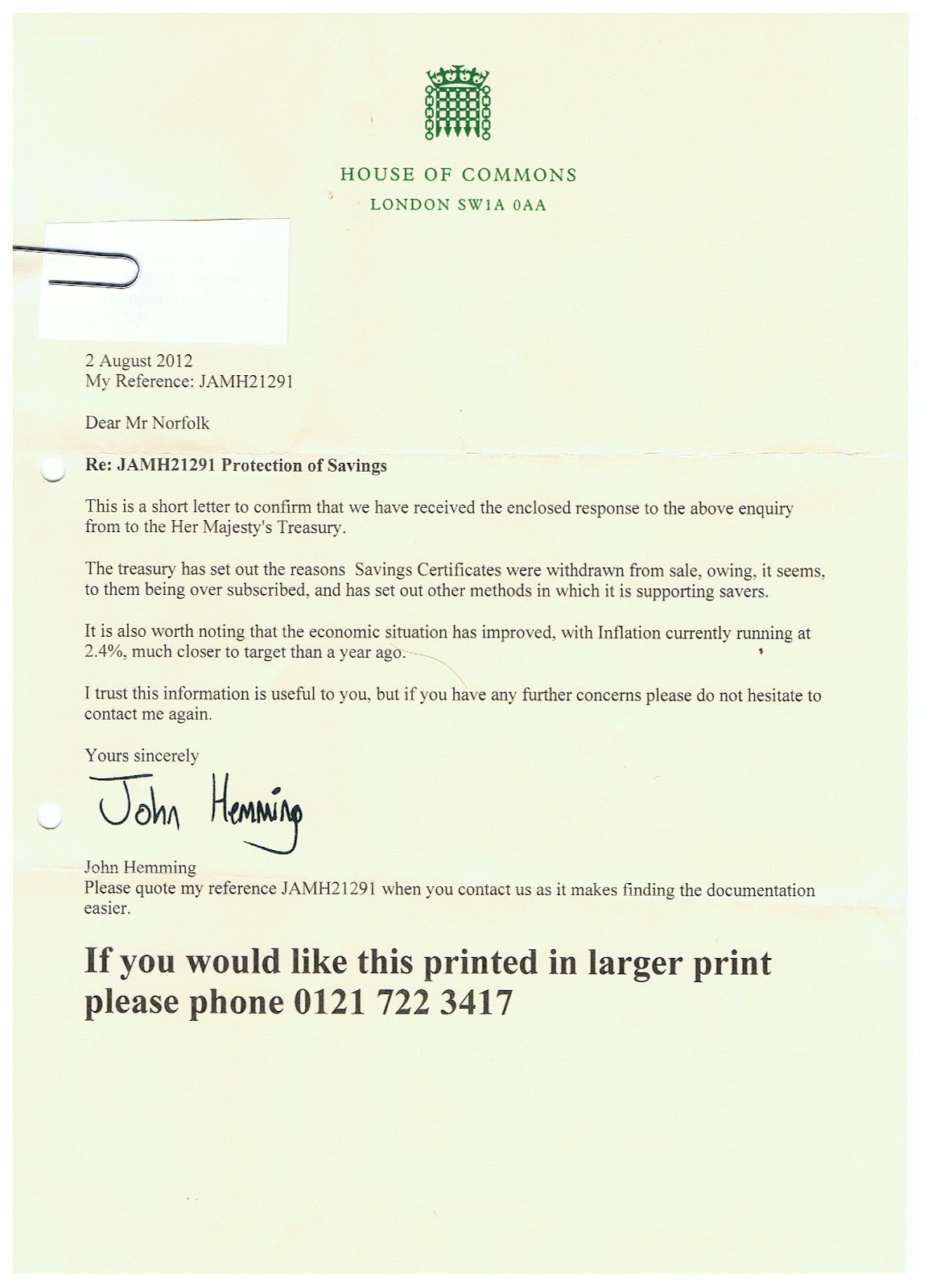
Cover letter from Mr Hemming to me (2 August 2012): (click to enlarge)

Main text of the above:
 
Re: JAMH21291 Protection of Savings
 
This is a short letter to confirm that we have received the enclosed response to the above enquiry from to the [sic] Her Majesty's Treasury.
 
The treasury has set out the reasons Savings Certificates were withdran from sale, owing, it seems, to them being over subscribed, and has set out other methods in which it is supporting savers.
 
It is also worth noting that the economic situation has improved, with Inflation currently running at 2.4%, much closer to target than a year ago.
 
I trust this information is useful to you, but if you have any further concerns please do not hesitate to contact me again.
 
Letter from Lord Sassoon to Mr John Hemming MP, 25 July 2012:
 
Main text of the above:
 
Dear Mr Hemming
 
Thank you for your letter of 2 July to George Osborne regarding correspondence from your constituent [...] about National Savings and Investments (NS&I). I am replying as Minister responsible for this policy area.
 
I appreciate that your constituent is concerned about savings in the current climate of relatively high inflation and low interest rates and is disappointed that Savings Certificates are no longer on sale. It is important, though, to recognise that inflation has come down from 5.2 per cent in September 2011 to 2.4 per cent in June 2012. The Government continues to give priority to reducing the impact of rising prices on families and businesses including through the recently announced deferral of fuel duty increases, which means that petrol prices will be 10p per litre lower than they would have been under the previous Government's plans.
 
NS&I provide cost-effective retail debt finance to Government. The money invested in their products contributes to the Government's overall debt financing remit. In doing this, NS&I follow a policy of balancing the interest of savers and the taxpayer with the stability of the financial services market. While doing so they aim to meet the financing objective set each year by HM Treasury.
 
It might be helpful if I explain the reasons why NS&I withdrew their Savings Certificates.
 
In July 2010, the popularity of both their index-linked and Fixed-interest Savings Certificates reached unprecedented levels and sales volumes far exceeded those either anticipated or required by NS&I to meet their financing target set by HM Treasury. Because of this, they took the difficult decision to take Certificates off sale on 18 July 2010. This change however did not affect existing customers.
 
The March 2011 budget confirmed NS&I's Net Financing target for 2011-12 as £2 billion with a range of £0-4 billion. To achieve this, they needed inflows of some £14 billion from sales and reinvestments during the year which gave them the ability to reintroduce one 5-year term of Savings Certificates on 12 May 2011. Their aim was to keep them on sale for a sustained period of time to enable as many savers as possible to invest.
 
As they expected, the Savings Certificates proved very popular and in just under four months they had received over 500,000 transactions. In order to stay within the Net Financing target range for the year, at this point they had to withdraw the certificates from sale.
 
Existing NS&I Savings Certificates customers can, on maturity, keep their investment for another term of the same length. Alternatively, they can reinvest into any of the other Savings Certificates terms and issues on offer to existing customers.
 
In more general terms, the Government wants a saving system based on freedom, fairness and responsibility, which is both affordable and effective.
 
To support and encourage savers the Government has:
 
  • ensured the amount that people can save tax-free is not eroded by inflation by indexing the amount that can be paid into ISAs each year. This means that the Government has increased ISA limits by £600 this year, including an extra £300 for cash ISAs;
  • announced at Budget 2012 that Government will work with industry to improve competitiveness and transparency in the ISA market, particularly by encouraging the industry to work towards faster ISA transfers;
  • introduced Junior ISAs, offering parent a clear, simple and tax-free way to save for their child's future;
  • confirmed that employees will have a new duty to automatically enrol qualifying employees into a pension scheme from October 2012. This has the potantial to encourage 5 to 8 million more people to start saving or save more into a workplace pension scheme. The Government is also establishing the National Employment Savings Trust (NEST) to provide a low-cost, high-quality pension scheme for individuals not currently served by the market;
  • set up the Money Advice Service to offer free and impartial information and advice on all money matters available online at www.moneyadviceservice.org.uk , face-to-face, or by calling its helpline on 0300 500 5000. The Money Advice Service also launched a financial health check to help people proactively manage their money. It also publishes comparative tables of savings accounts and the interest rates offered; and
  • given individuals more choice over the use of their pension savings to provide a retirement income by removing the effective requirement to purchase an annuity by age 75.
 
Please pass on my thanks to Mr Norfolk for taking the trouble to make us aware of these concerns.
 
Yours sincerely
 
James Sassoon
 
LORD SASSOON
 
Email from me to Mr John Hemming MP, 05 August 2012:
 
 Dear Mr Hemming
 
Thank you for forwarding Lord Sassoon's letter, which arrived here yesterday. It is not at all up to the standard that I would expect from a Treasury mind; in fact, it is little short of a disgrace.
The first page confirms what I suspected, that the present Government is concerned only with its own funding needs and not at all with what should be its commitment to savers, not to say the currency (which according to the BoE's own website has lost 99% of its value since 1900). As you know, National Savings Index-Linked Certificates were introduced in 1975, a year in which RPI inflation was, as I said to you before, 24.2%. If the government of the day could bring in this product at such a time of crisis and galloping inflation, I cannot see any justification for the present hiatus.
The point about the present level of inflation is useless. Savers need to know for sure that their money retains its spending power over the chosen period, not to be informed from time to time that RPI may have temporarily dipped.
The second page slides further downhill into irrelevant party political nonsense. To be specific about its failures to address the subject, I will take each of Lord Sassoon's points in order:
  • The cash ISA limit has nothing whatever to do with maintaining the purchasing power of cash.
  • ISA transfers, ditto.
  • Junior ISAs, ditto.
  • The NEST pension scheme is not a savings vehicle but an investment vehicle, a distinction that surely cannot have escaped someone with Lord Sassoon's background in the financial services industry. The nearest to cash within pension funds is either money market funds (which have a big fat question mark over them at the moment, I can tell you as an IFA) or bank/building society cash funds that (a) usually offer a significantly lower rate than cash ISAs and (b) are (except perhaps for SIPPs) not covered by the FSCS in the way that individually held accounts are (see the Pensions Advisory Service's article here).
  • The Money Advice Service is also irrelevant to the purchasing power of cash savings.
  • Changes to the requirement to purchase an annuity at age 75, ditto.
Sir, you have established something of a reputation as an MP who is prepared to ask awkward questions in Parliament, irrespective of party political aspects. This question is inconvenient to the present administration, but crucial to the financial wellbeing of many people throughout the country. I do not think it is ethical for the government to take the view that the man in the street must be forced to accept investment risk, merely when he decides to set aside some money for tomorrow instead of spending it today. His prudence should not be seen as an opportunity to shear his fleece with inflation.
May I respectfully request that you take this further to PMQs or Questions to Ministers, and make a proper fuss?
Yours faithfully
 
Answer (same day):

Parliament is not sitting at the moment.

I will look at the letter later next week (I am at a funeral on Monday) and come back to you on this. The sovereign debt issue is a very serious issue, however

Email from me to Mr John Hemming MP, today (03 March 2013):

Dear Mr Hemming
Thank you for your reply to my previous email.
Now that:
  •  the British Government creditworthiness has been downgraded by Moody's,and
  • the pound has dropped, and
  • inflation looks set to rise further, especially for imports;
- may I ask you to pursue my query vigorously in Parliament?
May I also draw your attention to two passages in Hansard from 1975 that make it perfectly clear that Government recognises the moral obligation to protect the value of savers' money?
__________________________________________________

Does the Minister accept that the opportunity to invest in inflation-proof schemes is an act of belated social justice to millions of people who have seen their savings irreversibly damaged during the recent rapid rise in the rate of inflation? Will he make recompense to many of them by easing up on his vindictive attacks on the principle of savings embodied in the capital transfer tax and the wealth tax?

The hon. Gentleman has put his supplementary question at the wrong time, because National Savings are rising very well at present. I am sure he will be delighted to hear that. As to what he called "belated social justice", I am sure he will pay due attention to the fact that the scheme was introduced by a Labour Government and not by a Conservative Government.
Is the Chief Secretary confident that a further extension of index-linked schemes—which are welcome to savers—will not cause a diversion of funds away from deposits with building societies, leading to a rise in the mortgage interest rate?
We are, indeed, aware of those problems. That is precisely why we introduced the scheme in this limited way.
Hansard record of House of Lords debate, 4 November 1975:

Lord LEE of NEWTON

My Lords, does my noble friend agree that while the index-linked schemes are extremely good value for money, it would be a good idea—as inflation has been rather rampant—to increase the maximum amount that can be invested in them?

My Lords, the Government have two conflicting obligations. One is an obligation to the taxpayer to buy goods and services as economically as possible, and secondly there are certain social obligations. The Government believe that by the action they have taken they have got the right balance.
________________________________________________
On 22 July last year, you offered to allow me to work with your researcher to draft a Parliamentary question on this subject. May I ask whether that offer is still open?
Yours sincerely